
Background
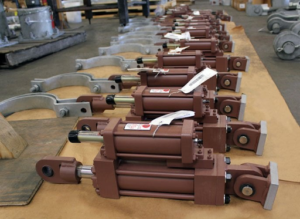
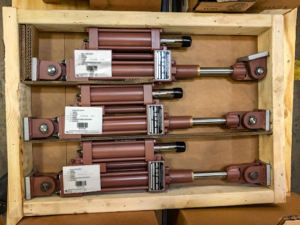
A major refinery operating an extensive steam piping network flagged seventeen hydraulic snubbers on 650 PSIG and 200 PSIG steam headers for evaluation. The units serve a seismic and dynamic restraint function on critical high-energy piping.
The seventeen snubbers consisted of two physical configurations:
- Eight shorter units installed on the 200 psig steam headers (Group A) and
- Nine longer units installed on the 650 psig steam headers (Group B).
When Fronek Anchor/Darling was engaged to support the replacement program, the plant had no access to original design documentation. No drawings, no load ratings, no stroke specifications, and in several cases, no confirmed manufacturer identity were on file.
What Was Found in the Field
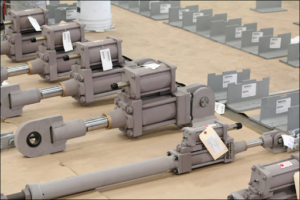
For Group A, nameplate analysis conducted by Fronek’s engineering team produced a working identification with moderate confidence. Based on available evidence, the “BE” designation is believed to represent Basic Engineers, the original manufacturer, and the size designation “2 x 5” was interpreted as a 2-inch bore with a 5-inch stroke. This provided a usable, though not fully verified, engineering baseline for specifying equivalent replacement hardware.
For Group B, the nameplate information available in the field did not contain sufficient detail to establish load ratings, stroke lengths, or device type with any engineering confidence.
As Jawad Uppal, P.Eng, PMP, Engineering Manager at Fronek Anchor Darling, noted:
“For the other nine snubbers, the nameplate information provided does not contain sufficient detail for us to reliably establish or even venture a reasonable estimate of the original load rating and stroke length. In the absence of historical drawings, design documentation, or manufacturer records, the most technically defensible approach would be to perform a pipe stress analysis.”
Solution
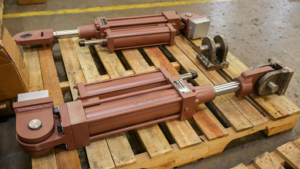
The absence of original selection documentation required a multi-phase remediation effort:
- PT&P’s Field Services division was engaged to coordinate the site visit, collecting dimensional data, confirming stroke requirements, and capturing 3D scan isometrics using LiDAR technology for undocumented piping geometry.
- A full pipe stress analysis was initiated for all nine Group B snubbers by PTP to determine load demand and establish code-compliant replacement specifications.
- For Group A, nameplate-derived sizing assumptions required engineering verification before any replacement hardware could be ordered.
- No replacement hardware was specified or ordered for Group B until the stress analysis was complete. The units remained in service in their current, unconfirmed state pending the outcome of the analysis.
With PT&P’s in-house field services, pipe stress analysis, and LiDAR scanning capabilities, the plant received a fully coordinated engineering response. Which was faster and more reliable than managing multiple external contractors across the same scope.
Cost Impact
| Cost Category | Description | Severity |
| Engineering Re-analysis | Full pipe stress analysis required for 9 units with no usable selection baseline | HIGH |
| Field Mobilization | Site visit to collect dimensional data, stroke measurements, and 3D scan isometrics | MODERATE |
| Documentation Recovery | Manufacturer ID via nameplate analysis; partial success on 8 of 17 units | MODERATE |
| Replacement Risk | Without confirmed design loads and stroke requirements, replacement hardware may be undersized, oversized, or improperly configured, potentially compromising system performance. | CRITICAL |
| Schedule Delay | A multi-week coordination cycle before replacement hardware can be specified or ordered | HIGH |
Summary
The cumulative cost of this engineering re-analysis, field measurement, mobilization, coordination efforts, and procurement delays significantly exceeded what proper upfront selection engineering would have required. Original snubber selection documentation should be treated as a long-term engineering asset throughout the lifecycle of the facility. Its absence creates a liability that surfaces at inspection, not at installation.
When selection data is missing, the technically defensible response is analysis, not assumption. Specifying a replacement based on estimated load ratings compounds the original error. Nameplate analysis can partially recover lost data, but only with engineering judgment and only for some units. It is not a substitute for documented design records.
To discuss a specific snubber application, review an existing installation, or request an engineering evaluation, contact the Fronek Anchor/Darling team or request a quote.