
Imagine holding a garden hose while water is flowing through it. Most of the time, the hose moves slowly and gently as pressure changes. But if someone suddenly turns the valve on or off very quickly, the hose can violently jerk and shake.
Industrial piping systems behave the same way.
Piping systems are designed to move. As temperatures/pressures change during normal operation, pipes naturally expand and contract. This movement is completely normal and is something engineers account for when designing a system.
The issue starts when the piping experiences sudden or violent movement
Events like water hammer, rapid valve closures, or equipment trips can create sudden dynamic forces that cause piping to shake violently, damaging pipe supports, welds, flanges, and nearby equipment.
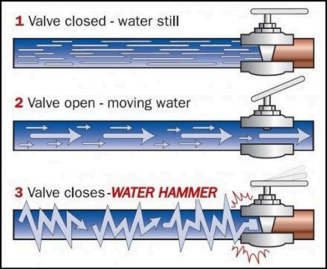
That’s where a pipe snubber (also known as a dynamic pipe restraint) comes in.
A snubber is a restraint device that allows slow thermal movement during normal operation, but locks up and resists sudden movement during an abnormal event. In simple terms, it acts very similar to the shock absorbers on a car or seat belts— flexible during normal conditions, but resistant during sudden impact.
This is what makes snubbers unique compared to rigid pipe supports. A rigid pipe support constantly restricts movement, whereas a snubber only reacts when movement becomes too rapid.
So why not just rigidly support the pipe everywhere?

Because piping systems need to move during normal operation. If a high-temperature pipe were fully restrained, thermal expansion could create very large stresses in the piping system, supports, and connected equipment. Snubbers solve this problem by allowing slow thermal movement while still protecting the system during sudden transient events.
Thermal expansion occurs slowly over time and is considered a low-speed or “static” type of movement. Events such as seismic activity, water hammer, or valve slam occur very quickly and are considered “dynamic” movement.
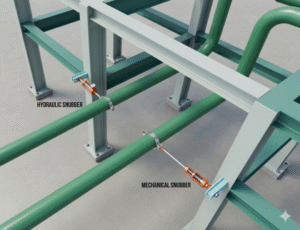
Snubbers are commonly used in systems that carry fluid at high pressure, high temperature — or both — such as steam, feedwater, or process piping in power and industrial plants. These systems must be able to expand and contract during normal operation while still being protected against dynamic events.
For example, in a steam power plant, a long steam line may grow several inches as it heats up during startup. The snubber allows this slow movement naturally, but would resist sudden pipe movement caused by a steam hammer or seismic event.
Snubbers are especially common in nuclear, fossil power, petrochemical, aerospace, and other critical process industries where piping reliability and system safety are essential.
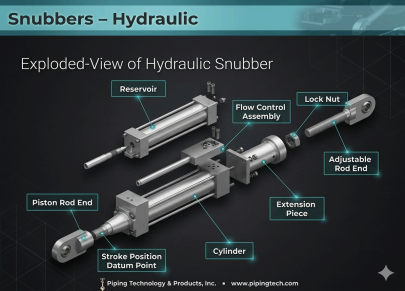
Think of the diagram above as the “insides” of a typical hydraulic snubber. The main cylinder holds a piston, while the reservoir is filled with hydraulic fluid that manages how things move. During normal thermal expansion, fluid travels slowly through the control assembly, letting the pipes drift naturally. But if the pipe tries to jerk away, the flow restriction locks up to stop the fast motion. Other parts, like the rod ends and extension pieces, act as the connectors that hook the snubber to the building and the piping itself.
In simple terms, a snubber acts like a “smart restraint” for a piping system — flexible during normal thermal movement, but strong during sudden dynamic events. This allows piping systems to operate safely without introducing excessive stresses during normal plant operation.