
Background
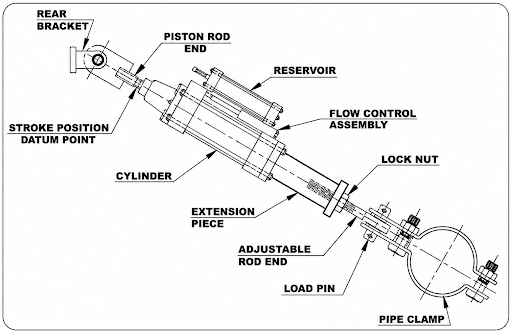
Snubber specification errors are often predictable and preventable. A specification may appear complete on paper, allowing procurement to move forward, but critical issues often emerge only when the snubber arrives on site. Common problems include an incorrectly installed length or insufficient stroke to accommodate the actual thermal movement of the piping system. By this stage, the consequences extend far beyond replacing a single component. It includes expedited re-orders, field rework, and schedule impact that could have been avoided at the specification stage.
The three cases below are drawn from actual customer engagements handled by Fronek Anchor/Darling. Each one involved a hydraulic snubber specification that was incomplete or ambiguous at the time of order. In each case, Fronek’s engineering team identified the gap before fabrication and resolved it through direct technical clarification. The cases span industrial, geothermal, and refining applications, but the terminology risks they illustrate are common across every sector where snubbers are used.
Problem
In all three engagements, the purchase order or RFQ contained specification data that appeared complete on the surface. Pin-to-pin dimensions were listed, stroke values were referenced, and assembly types were identified. The problems were not missing fields. They were dimensional values that had been carried forward from catalog references rather than derived from the actual installation geometry, assembly configurations where a critical take-out dimension had not been calculated, and stroke approvals that had not been validated against the actual thermal displacement at the installation point.
Case 1 — When a Catalog Dimension Is Not an Installation Dimension
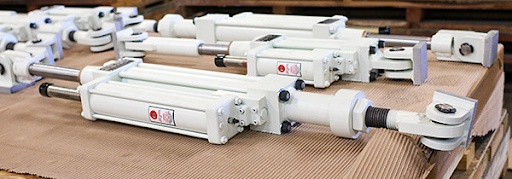
A purchase order was placed for a series of hydraulic snubbers. The customer’s data sheet referenced a pin-to-pin dimension of 23-1/4″. That figure matched a value published in the Fronek product catalog, which raised an immediate engineering flag.
The catalog value of 23-1/4″ represents the snubber’s pin-to-pin at mid-stroke, which is the factory standard preset position. A customer referencing that catalog dimension does not necessarily require the snubber at that preset. In many cases, the value is carried over from the catalog as a reference point, without being validated against the actual installation envelope.
Fronek’s engineering team flagged the ambiguity before the order was processed:
“Can you confirm whether the client specifically requires a pin-to-pin length of 23-1/4″, or if they are referencing that value from the catalog? The 23-1/4″ represents the snubber at mid-stroke, but this needs to be confirmed against the actual installation envelope before we proceed.”
The clarification confirmed the customer was referencing the catalog value, not specifying a fixed installation constraint. The correct pin-to-pin was established based on the actual structural attachment geometry and the pipe’s thermal displacement in the cold position. The snubber was ordered at the appropriate preset to accommodate field conditions, not at the catalog default.
Terminology Applied
- Pin-to-Pin: Confirmed as the governing installation dimension, not the cylinder length alone. All attachment hardware take-outs were included in the final dimension.
- Preset Position: Set to place the rod at a position ensuring adequate stroke in both the direction of thermal growth and thermal contraction.
- Cold Position: Defined as the installed condition at ambient temperature, from which thermal displacement in the hot direction is measured.
Case 2 — Type B Assemblies and the Missing Clamp Take-Out
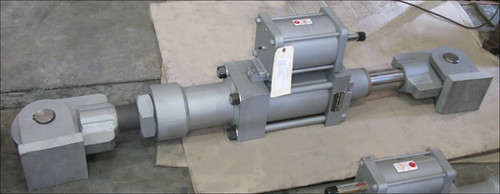
Fronek received an RFQ for seven hydraulic snubbers for an industrial customer. The data sheet specified two snubber types, SN3 and SNB4, both configured as Type B assemblies. Type B snubbers include a pipe clamp as part of the assembly.
Calculating pin-to-pin for a Type B assembly requires the clamp take-out: the dimension from the pipe centerline to the clevis pin hole on the clamp side. Without this value, pin-to-pin cannot be reliably calculated, even when the structural attachment side is fully defined.
Fronek’s engineering review identified the gap before responding to the customer:
“For Snubbers SN3 and SNB4, they’re looking for Type ‘B’ which comes with a clamp. I need to know what the clamp take-out is to approximate the pin-to-pin. I’m still waiting on the clamp take-out measurement to finalize the P2P.”
The clamp take-out was obtained prior to order finalization. Pin-to-pin was then calculated correctly for all seven snubbers, incorporating the structural attachment take-out on the structure side and the clamp take-out on the pipe side.
Terminology Applied
- Pin-to-Pin: Dependent on take-out at both ends. Structural attachment and clamp hardware dimensions are both required. Neither alone is sufficient.
- Stroke: Confirmed against the expected thermal displacement at each installation point to ensure the preset would leave adequate travel in both directions.
Case 3 — Stroke Approval Without Displacement Analysis
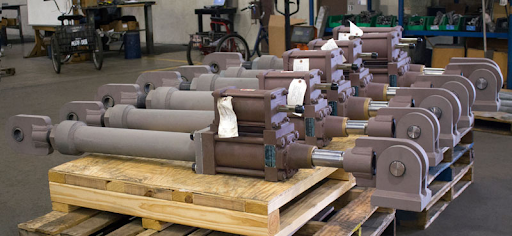
A geothermal power generation customer engaged Fronek for a multi-unit snubber supply across several load ratings with varying stroke requirements. Technical data sheets were exchanged and reviewed collaboratively before fabrication.
During the drawing review, the customer’s engineering team raised questions about stroke adequacy for one of the specified units. A 6-inch stroke was proposed, and the customer confirmed approval. The discussion also identified a broader issue: the engineering group was not fully familiar with how snubber dimensional parameters interact with installation geometry.
Approving a stroke value is only meaningful when the underlying calculation has been performed. Thermal displacement in the direction of the snubber axis, at the correct installation point, must be established before a stroke can be validated.
The 6-inch stroke was confirmed through a collaborative data sheet review, validating the travel against anticipated thermal displacement at each installation point. Separately, Fronek’s engineering team developed and delivered a dedicated technical training session for the customer’s group, covering snubber selection, installation parameters, and dimensional terminology, including stroke, preset, cold, and hot position, and pin-to-pin.
Terminology Applied
- Stroke: Confirmed at 6 inches for the applicable units, validated against thermal displacement in the snubber axis direction.
- Cold/Hot Position: The basis for the displacement calculation. Cold (shutdown) to hot (operating) defines the thermal travel the snubber must accommodate.
- Lock-Up Velocity: Reviewed during training as part of hydraulic snubber selection guidance for geothermal applications, where thermal transients are slow but seismic exposure is a design consideration.
The terminology gaps identified in this engagement are covered in depth in The Snubber Terminology Guide. A reference built around the parameters that caused specification errors in all three cases above.
Summary
| Case | Core Terminology Risk | Outcome |
| Case 1 – Industrial Refinery | Catalog P2P referenced as installation P2P | Correct P2P established against the field geometry. Snubber ordered at the proper preset. |
| Case 2 – Industrial | P2P calculation is incomplete without a clamp take-out. Type B assembly requires both end dimensions. | Clamp take-out obtained. P2P confirmed for all seven units before the order. |
| Case 3 – Geothermal | Stroke approved without underlying displacement analysis. The team lacked dimensional terminology familiarity. | Stroke confirmed by analysis. Technical training session delivered to close the knowledge gap. |
In each case, the risk was not structural failure. It was a specification error that would have produced the wrong device or an incorrect installation. The cost of that error, in expedited re-orders, field rework, and schedule impact, would have far exceeded the cost of the clarification that prevented it.
To discuss a specific snubber specification, confirm pin-to-pin, preset, or stroke requirements, or request a technical review of an existing installation, contact the Fronek Anchor/Darling team or request a quote.